











Magic: The Gathering: a history of the first modern TCG
Magic: The Gathering created the trading card game as a genre in 1993. This is how it began, how it grew into a billion-dollar brand and why its oldest cards are still the most sought after.
Updated 27 Sep 2026 · 5 min read · CardTrading
Contents
Every trading card game on the shelves today descends, directly or indirectly, from one box of cards released in the summer of 1993. Magic: The Gathering introduced the idea that each player builds a personal deck from a large pool of collectible cards, and more than three decades later it is still one of the biggest games in the hobby.
Origins: a game you could play between convention events
Richard Garfield has told the story himself on the official Magic site. He and a friend visited Wizards of the Coast, then a small company in the Portland area, to pitch a board game, RoboRally. Founder Peter Adkison and his partner liked it but were not ready to publish a board game. What Adkison wanted instead was something quick to play, light on equipment and suited to conventions.
Garfield, then a graduate student at the University of Pennsylvania, worked on the idea in his spare time. He says the core concept came within days and built on two earlier designs of his: a card game called Safecracker from 1985 and a game called Five Magics. The first playable version had 120 cards, and his first late-night test game ran for hours.
Wizards of the Coast released the finished game on 5 August 1993. Guinness World Records lists it as the first modern trading card game and credits "Professor Richard Garfield" as its creator. Wizards itself describes the launch modestly: in August 1993 the game went on sale in hobby and game stores, mostly on the West Coast of the United States.
1993: Alpha, Beta, Unlimited and the first expansion
The first print run is known to collectors as Limited Edition Alpha. It was followed by Limited Edition Beta and later by Unlimited Edition. According to Magic's head designer Mark Rosewater, the three randomised booster releases of 1993 were Alpha, Beta and Arabian Nights, the game's first expansion.
Rosewater credits Garfield with three ideas that still hold the game together: the trading card game concept itself (you choose which pieces to play with), the colour wheel of five colours of magic, and the mana system that paces every game.
Milestones: from hobby game to billion-dollar brand
Organised play
Wizards of the Coast held the first Pro Tour in New York in February 1996. The official oral history remembers a blizzard that nearly shut down the event and a $12,000 first prize, an unusual sum for a game tournament at the time. Behind it was a simple idea from Garfield: taking the game seriously at the top would help it at every level, the way professional basketball does for the sport.
Hasbro and a global audience
Hasbro acquired Wizards of the Coast in the fourth quarter of 1999. Its annual report for that year described Magic as a game created in 1993 with more than six million players in 52 countries. By 2016, Guinness World Records was citing Wizards' estimate of more than 20 million players worldwide and translations into over ten languages.
The first billion-dollar year
In February 2023 Hasbro reported that Magic had a record year in 2022 and exceeded $1 billion in revenue for the first time, calling it the company's first billion-dollar brand.
Thirty years of Magic
Wizards marked the game's 30th anniversary with a celebration that ran through 2023, including a Magic 30 event in Las Vegas, anniversary promos in stores and a commemorative, non-tournament-legal 30th Anniversary Edition.
Iconic cards and why they matter
Wizards of the Coast's own feature on the "Power Nine" names the nine cards that collectors and Vintage players still treat as the game's crown jewels: Black Lotus, Time Walk, Ancestral Recall, Timetwister and the five Moxen (Sapphire, Jet, Ruby, Pearl and Emerald). Black Lotus from Alpha is the best known of them.
Collectors distinguish carefully between printings. The same Black Lotus appears in Alpha, Beta and Unlimited, and each printing has its own market price. You can compare them in our catalog: Beta Black Lotus and Unlimited Black Lotus.
Curiosities
- The Reserved List. Wizards' official reprint policy says reserved cards "will never be printed again in a functionally identical form". The policy covers only physical cards, not digital ones, no new cards will be added, and nothing from Mercadian Masques onwards is reserved. Black Lotus is on it.
- Necropotence's surprise. At the first Pro Tour, the Juniors division was won with a Necropotence deck, a card that magazines had rated poorly before the event.
Collecting Magic today
The collector market for Magic has two very different ends. At one end are modern sets, released several times a year, where most cards are affordable and prices move with what is played in formats such as Standard or Commander. At the other end are the 1993–1994 cards, whose supply is fixed. The Reserved List is central to that second group: because Wizards has committed not to reprint those cards in functionally identical form, supply of cards like Black Lotus can only shrink as copies are lost or damaged.
Condition and grading matter a great deal at the top end. The record sales reported in the press all involve graded copies at or near the highest grade, and even a small difference in grade can change the price of an Alpha card significantly. For most collectors the practical questions are simpler: which printing is it, what condition is it in, and what have similar copies sold for recently.
To follow the market, see the most valuable cards on the Magic game page, check recent price changes on market movers and read how our indices are built. If you already own cards, the portfolio tracker keeps a running estimate of their market value, and our glossary explains terms like "Reserved List" and grading scales.
Market data for information only. Not investment advice.
Related cards
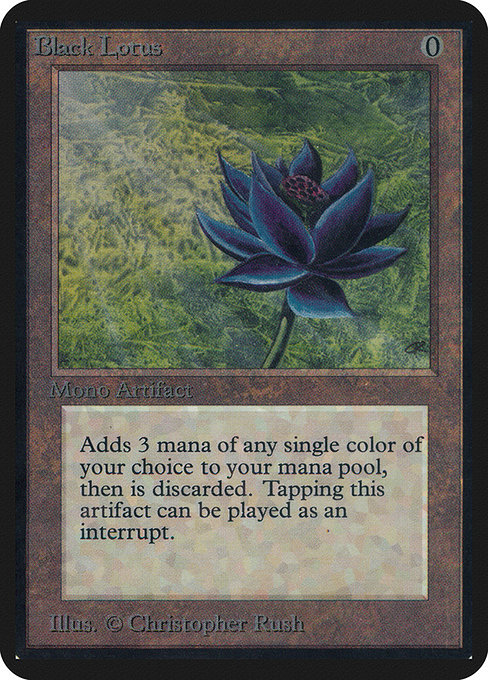 Black LotusLimited Edition Alpha · #232 · Magic: The GatheringMarket price€33,768.47
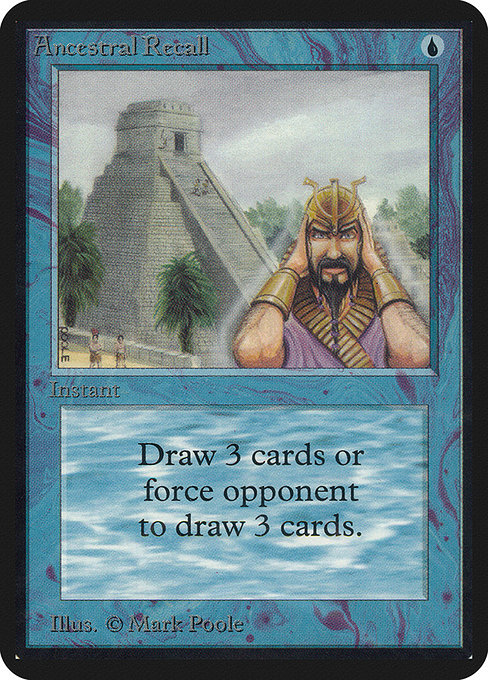 Ancestral RecallLimited Edition Alpha · #47 · Magic: The GatheringMarket price€17,278.17
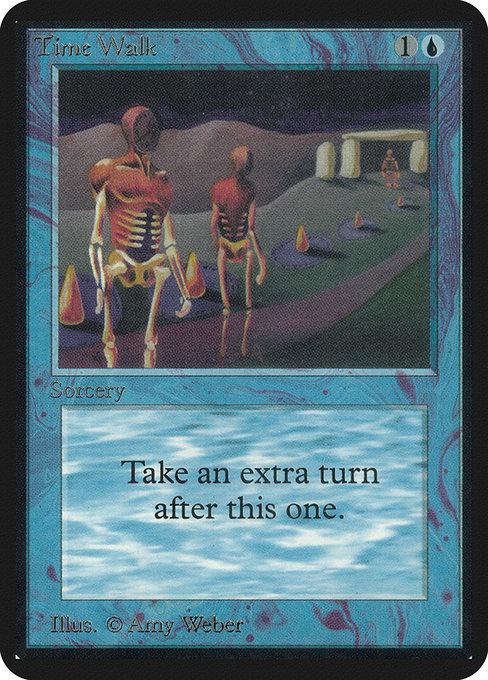 Time WalkLimited Edition Alpha · #83 · Magic: The GatheringMarket price€16,490.92
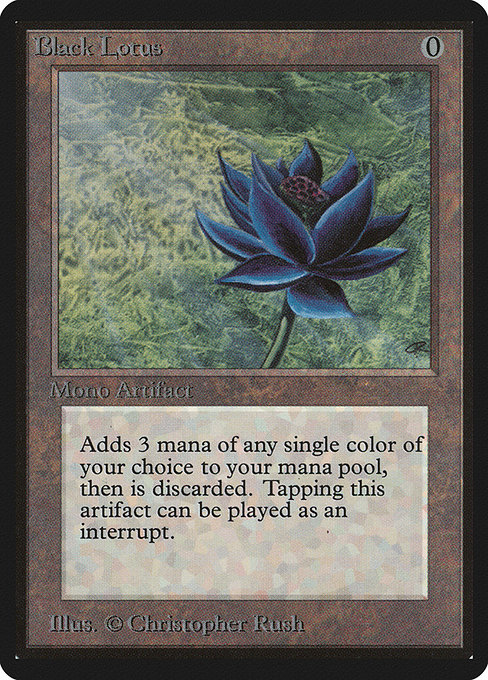 Black LotusLimited Edition Beta · #233 · Magic: The GatheringMarket price€22,454.09
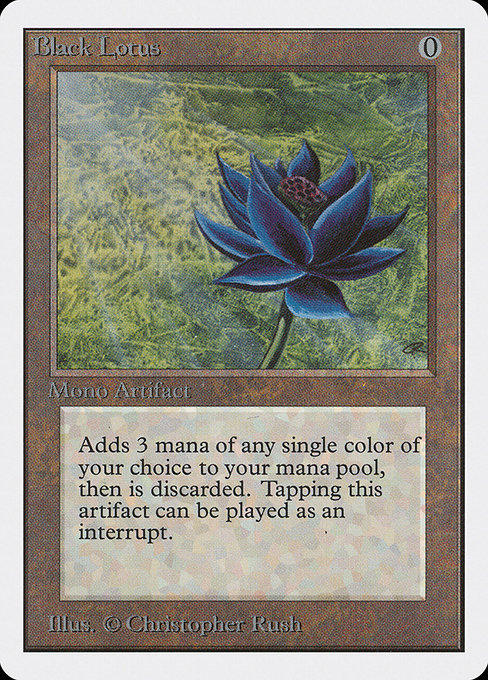 Black LotusUnlimited Edition · #233 · Magic: The GatheringMarket price€14,052.34
Related sets
Limited Edition AlphaMagic: The Gathering · released 5 Aug 1993 · 295 cardsCard list and prices →Limited Edition BetaMagic: The Gathering · released 4 Oct 1993 · 302 cardsCard list and prices →Unlimited EditionMagic: The Gathering · released 1 Dec 1993 · 302 cardsCard list and prices →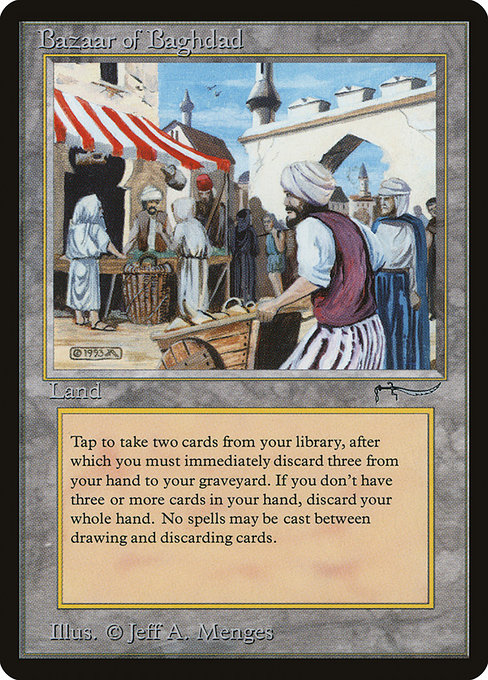 Arabian NightsMagic: The Gathering · released 17 Dec 1993 · 92 cardsCard list and prices →
Sources
- First modern trading card game — Guinness World Records
- Most played trading card game — Guinness World Records
- The Creation of Magic: The Gathering — Wizards of the Coast
- Looking Back, Part 1 — Wizards of the Coast
- An Oral History of the First Pro Tour — Wizards of the Coast
- The Power Nine — Wizards of the Coast
- Official Reprint Policy — Wizards of the Coast
- Kicking off Magic's 30th Anniversary Celebration — Wizards of the Coast
- Hasbro, Inc. Form 10-K405 for fiscal year 1999 — Hasbro, Inc. (U.S. Securities and Exchange Commission)
- Hasbro Reports Fourth Quarter and Full-Year 2022 Financial Results — Hasbro, Inc. (U.S. Securities and Exchange Commission)